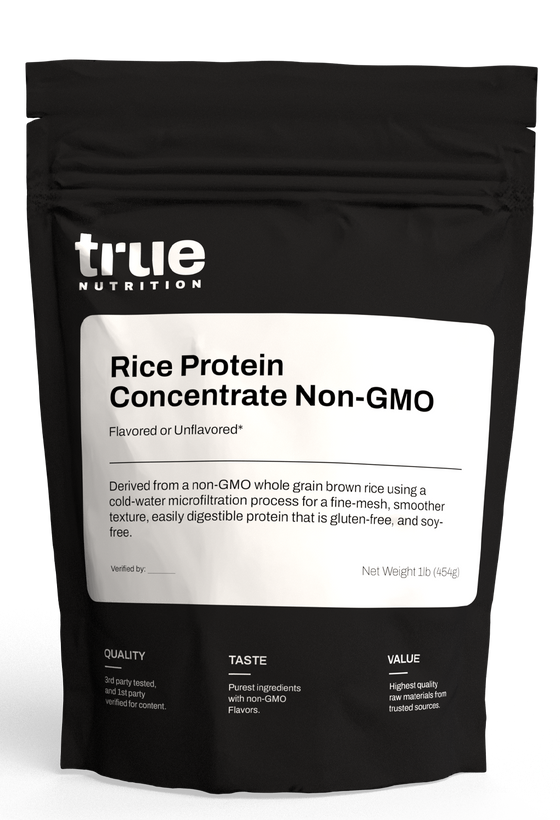
Rice Protein Concentrate – non-GMO (1lb.)
14 servings $1.32/Serving
Select quantity
Select packaging
Scoops (90cc)
Delivery Frequency
- Save 15% on every order
- Adjust, pause or cancel anytime
Buy 7lbs or more and save 5% in checkout
Customize to select flavor intensity and add boosts
Product Details
-
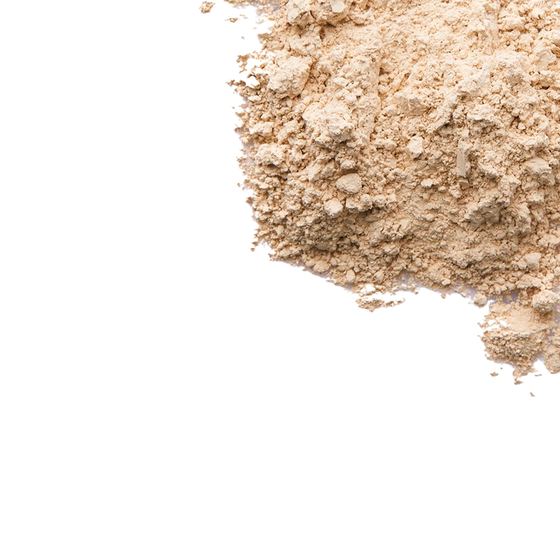
Our Rice Protein Concentrate derives from non-GMO whole grain brown rice using a cold-water microfiltration process. The end product is a concentrate with a fine-mesh powder for a smoother texture.
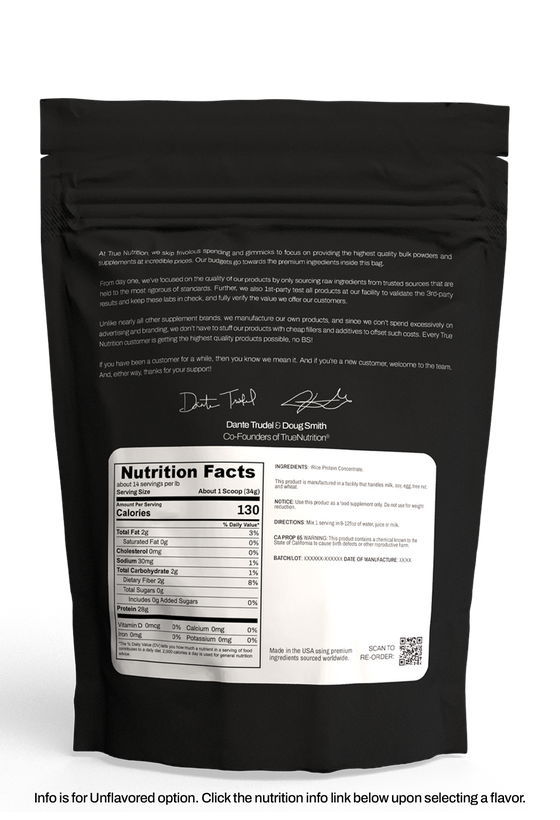
Ingredients: Rice Protein Concentrate.
Amino Acid Profile (Per 100g)Amino Acid Amount Alanine 6.08g Arginine 9.10g Aspartic Acid 8.82g Cystine 2.75g Glutamic Acid 16.10g Glycine 4.54g Histidine 2.46g Isoleucine 4.44g Leucine 7.81g Lysine 3.19g Methionine 2.61g Phenylalanine 6.05g Proline 4.68g Serine 5.10g Threonine 3.79g Tryptophan 1.31g Tyrosine 5.39g Valine 5.77g -
A low score is not a strike against a product
It means researchers haven't studied that pairing yet. Whey isolate scores low for joint health because almost no one has tested it there, not because it works against your joints. A score reflects the state of the research — not product quality, purity, or nutrition content. Most pairings sit low for the same reason: research funding has concentrated on a handful of well-studied questions, and everything else is simply unexamined.
What the number means
Each score estimates how strong the published human research is between one product and one goal. We weigh study design first (meta-analyses and randomized controlled trials count for more than mechanistic or animal data), then sample size, consistency across studies, and how recent the work is. The score says nothing about quality, safety, purity, or nutrition content.
9–10 Extensively studied: Multiple meta-analyses or systematic reviews of RCTs, pointing the same direction.
7–8 Well studied: Multiple RCTs on this product, or on its immediate class, for this outcome.
4–6 Some research: Human trials exist but are small, short, mixed, or run on a closely related substance.
2–3 Early research only: Mostly mechanistic, animal, or lab evidence. Plausible, not yet established in people.
1 Not yet studied: No meaningful research connects this product to this goal.
Why some goals aren't scored for some product types
Not every goal is a question you can meaningfully ask of every product. Carb powders have nothing to say about hormone support, and a fruit powder has nothing to say about muscle growth. Asking anyway would produce a column of 1s that reads like a verdict rather than an absence. Each product is scored only against the goals its research literature actually addresses. In the grid, those cells are marked as not scored rather than given a number.
What "pending review" means
Some products have been identified and their reasoning written, but the literature review isn't complete. Those carry no citations yet and we don't claim an evidence tier for them — the number shown is a working placeholder, not a finding.
How blends are scored
Some products are single substances and some are blends of several. When a product is a blend, we score the product as a whole and name the component the evidence actually comes from — so a greens blend's gut score is attributed to the greens in it, and a pre-workout's energy score to the caffeine and beta-alanine in it. The research was run on those components, not on our particular formula, and saying so is the difference between a citation and a claim.
Why some products share a score
Products built on the same underlying substance share a score, because that substance is what the studies actually tested. Trials run on standard whey isolate or a specific collagen peptide, not on a branded product. Where a variant has a documented functional difference, such as hydrolysis speeding digestion, we note it in that product's reasoning instead of inventing a separate score.
What "what the research studied" means
That column names the exact form used in the underlying studies: whey protein isolate, hydrolyzed collagen peptides, pea protein isolate. We include it so nothing here reads as a claim that our specific products have been clinically tested. The studies are on the substance. Our products are built from that substance.
About the study links
Where a score links out, that link points to a real, published human study (PubMed, PMC, or the journal's own page) that fed into that score — not a single citation "proving" the claim, but one of the studies actually reviewed. Not every score has a linkable study behind it: many reflect a body of general nutrition research (protein intake and satiety, for example) rather than one paper, and some reflect the informed absence of any research at all. In both of those cases we don't force a link.
Limits
This is a directional guide built from peer-reviewed, PubMed-indexed literature and published meta-analyses. It is not medical advice, and scores will move as new research publishes. We review it periodically rather than treating it as settled.
-
-
-
-
-
Clean, Honest Ingredients
- KDKerrion D.Verified BuyerRated 4 out of 5 stars1 week agoRice Protein
Very chalky, but it works for me.
- HMHillary M.Verified BuyerRated 5 out of 5 stars3 months agoVery Easy on the Stomach!
I’ve been in search for protein powders for the longest. I normally get my protein from Whole Foods but if I’m eating oatmeal or baking something, I like to make sure it has a bit of protein so I’m meeting my goals. Whey and Pea cause my stomach to be in the worst pain ever so when I found out about rice protein and tried it out, it was really easy on my stomach! No extra bloating or sharp pains! Will be buying again!
- JZJonathan Z.Verified BuyerRated 3 out of 5 stars3 months agovery earthy
use an extra strong flavor if you plan on having it by itself
- DMDavid M.Verified BuyerRated 5 out of 5 stars5 months agoVery Happy
The order came very promptly. And it’s perfect for the use I need.
- SCStephanie C.Verified BuyerRated 5 out of 5 stars7 months agoGreat plant-based protein!
Pea protein has been causing bloating issues and this has been a great swap - no issues from this and easily masked flavor with berries/honey/whatever else you prefer